Part 4: Do We Regret Our Career Choices?
Between Dreams and Paychecks Series
What “What If” Looks Like Over Time
At some point, most people ask a version of the same question:
What if I had chosen differently?
It’s not always driven by dissatisfaction. More often, it reflects awareness—an understanding that life could have unfolded along a different path. The data suggests this kind of reflection isn’t rare. In fact, it’s nearly universal.
When asked how often they think about “what might have been,” only 3.6% of respondents said never. The majority—78.1%—said they think about it sometimes, while another 6.8% said often. Taken together, more than 84% revisit alternative versions of their career at least occasionally.
But thinking about a different path is not the same as regretting the one you chose.
That distinction becomes clearer when we look at how people interpret their own decisions. When asked whether they feel they gave up on a dream career, only 24.8% said yes outright. A larger group—53.6%—answered somewhat, while 20.4% said no.
That middle category matters.
It suggests that for many, the feeling isn’t one of clear regret, but something more ambiguous. Not a sense of having made the wrong decision—but a sense that something wasn’t fully pursued.
This ambiguity carries through when people reflect on whether they would make the same choice again. Despite the prevalence of “what if” thinking, 35.9% of respondents said they would choose the same path, and another 51.8% said they probably would. Only 11.9% indicated they would likely choose differently.
In other words, nearly 88% of respondents believe their path was—at the very least—reasonable.
Most people think about “what might have been”—even if they don’t regret their choices.
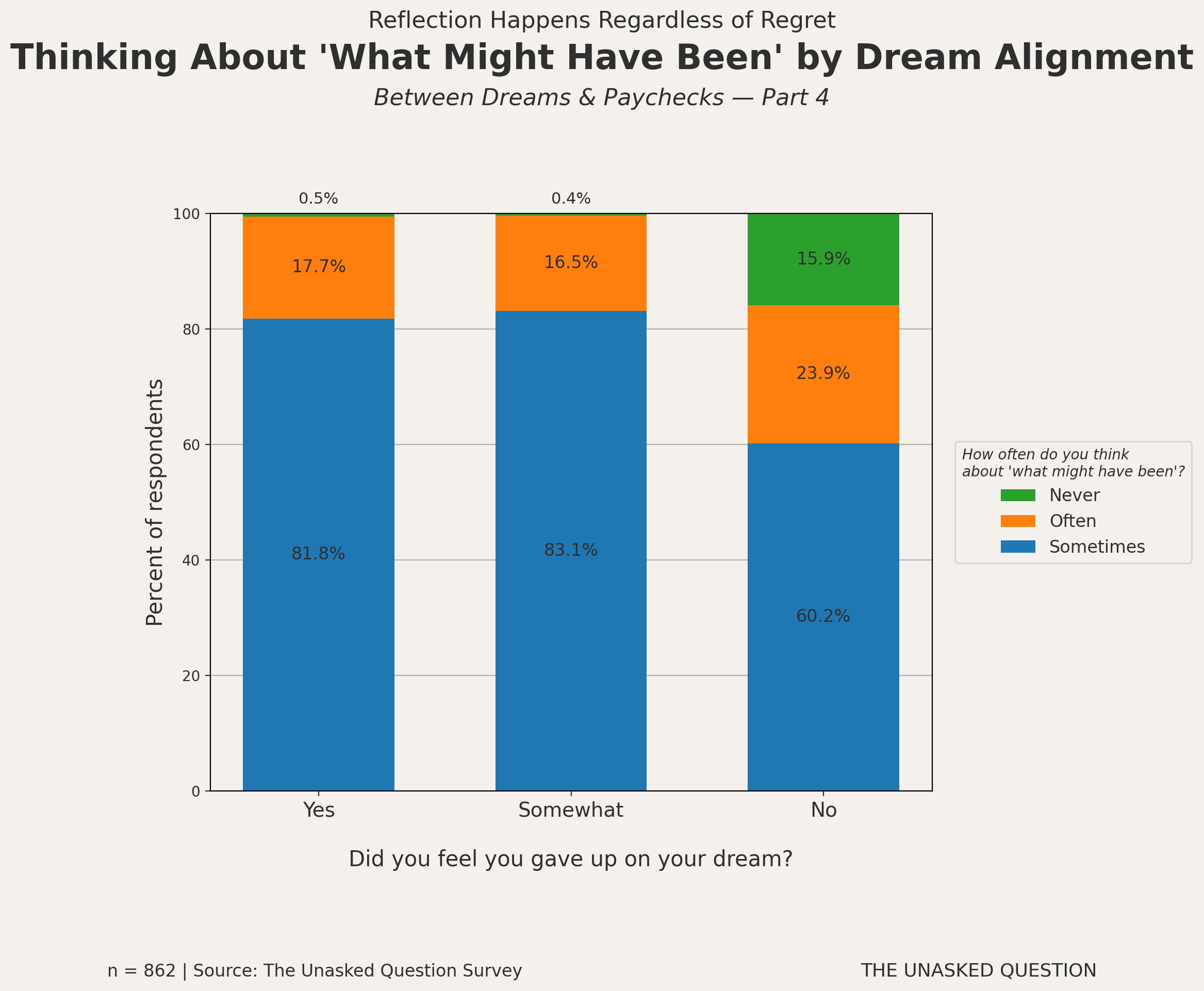
This chart compares how often people reflect on alternative career paths based on whether they feel they gave up their dream job. Even among those who say they did not give up their dream, the majority still report thinking about “what might have been,” suggesting that reflection is a common experience rather than a sign of regret.
This creates a paradox that sits at the center of modern career decisions.
People frequently imagine alternative outcomes.
Many acknowledge tradeoffs.
And yet, most would still make the same choice again.
This isn’t contradiction. It’s complexity.
But if reflection is widespread and regret is limited, where does doubt actually show up?
The answer isn’t where you might expect.
When comparing stress levels with whether people would choose the same path again, the relationship isn’t linear.
Those with low stress show strong confidence
Those with high stress also remain relatively decisive
But those in the middle are the least certain
Doubt doesn’t peak at the extremes. It peaks in the middle.
When things are clearly working, people feel confident.
When things are clearly difficult, people often feel committed or constrained.
But when things are somewhere in between—not failing, but not fully aligned—that’s where questioning tends to emerge.
Career doubt doesn’t peak when things are worst—it peaks when they’re just uncertain.
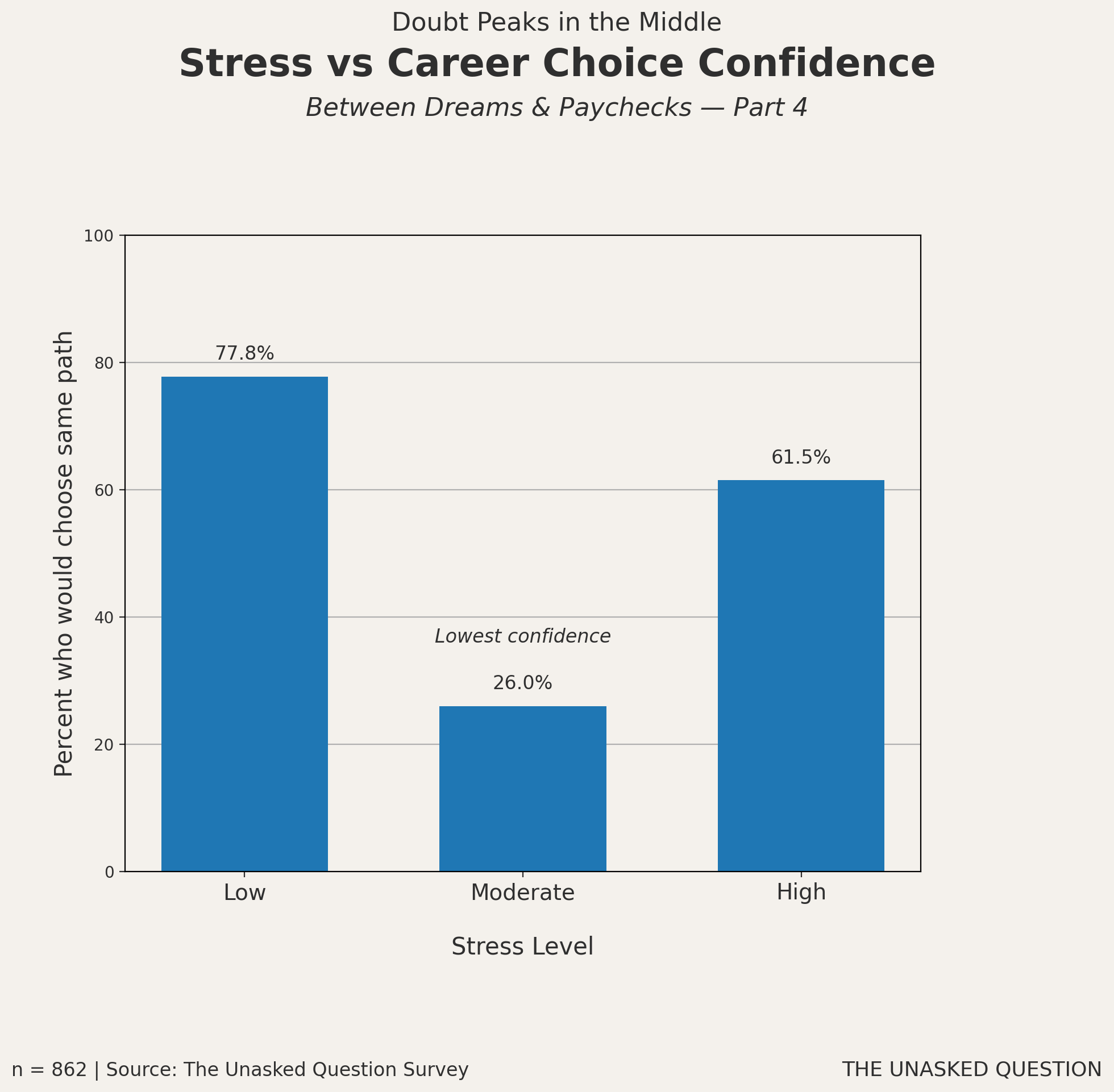
This chart explores how stress levels relate to career decision confidence. Interestingly, respondents experiencing moderate stress are the least likely to say they would choose the same path again, while those at both low and high stress levels show greater certainty. The findings suggest that uncertainty tends to emerge in the middle, rather than at the extremes.
What stands out most is that reflection exists even alongside positive outcomes. In earlier parts of this series, we saw that approximately 79% of respondents report mid-to-high career satisfaction, and around 70% feel financially secure. These are not indicators of widespread dissatisfaction.
Yet even within that context, people still wonder.
This suggests that “what if” thinking is not necessarily a sign that something is wrong. Instead, it reflects an awareness that multiple paths were always possible—and that choosing one inevitably means leaving others behind.
So the question isn’t simply whether people regret their careers.
A more accurate question might be:
How often do people reconsider them?
Because reconsideration appears to be far more common than regret.
Most people are not living with constant dissatisfaction. They are not looking to undo their decisions. But they are, at times, looking sideways—imagining alternatives, revisiting earlier versions of themselves, and reflecting on what might have been.
That reflection doesn’t always lead to change. But it does shape how people think about what comes next.
And that leads to the final question in this series:
If people are still reflecting on their choices…
Part 5 - Is It Ever Too Late to Change?