Part 5: Is It Ever Too Late to Change?
Between Dreams and Paychecks Series
Rethinking Timing, Risk, and Reinvention
At some point, reflection turns into a different kind of question.
Not What if I had chosen differently?
But - What would it take to choose differently now?
For many people, that question doesn’t come with a clear answer. It comes with hesitation.
When asked whether it’s too late to pursue their dream job, responses were split. 40.7% said yes. 34.8% said no. Another 22.4% said it depends. There’s no overwhelming consensus—only uncertainty.
Which, in itself, is revealing.
The idea of being “too late” isn’t a fixed reality. It’s a perception shaped by where someone stands in life—and what they believe is still possible.
By the time most people begin to seriously consider change, their circumstances look very different than they did when they first chose a path. Financial commitments are higher. Career momentum has built over time. Responsibilities extend beyond the individual. The same forces that once guided decisions toward stability and income don’t disappear—they become more entrenched.
And that shift isn’t experienced equally.
Age, income, and life stage begin to reshape how people interpret their options.
Younger respondents are more likely to say it’s not too late to pursue a different path. Older respondents, by contrast, are more likely to say it is too late—or that it depends. This isn’t simply about time passing. It reflects accumulated commitments, established careers, and a growing awareness of what change might cost.
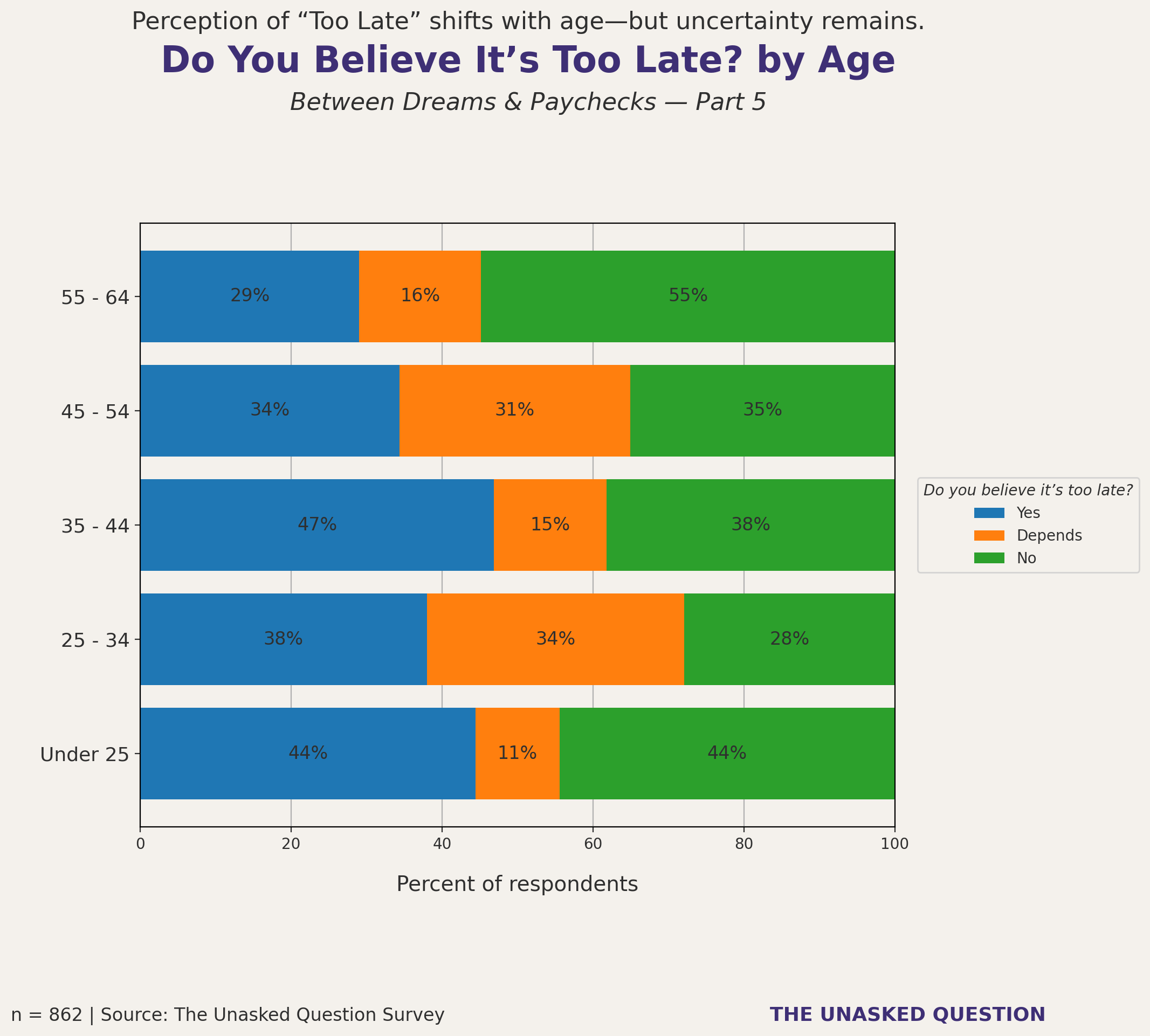
This chart illustrates how perceptions of being “too late” to pursue a dream career shift across age groups. Older respondents are more likely to say yes, while younger respondents are more likely to say no, with uncertainty present at every stage.
Income introduces a similar tension. Those with lower salaries are more likely to express a desire for change, while those with higher incomes tend to hesitate—not necessarily because they are more satisfied, but because the cost of disruption is higher.
The question shifts from What do I want to do? to What am I willing to risk?
Parenthood sharpens that calculation even further. Respondents with children are more likely to prioritize stability, more likely to say it’s too late—or uncertain—and less likely to pursue major changes. Not because ambition disappears, but because the consequences of risk extend beyond the individual.
In that sense:
Reflection may be universal—but the ability to act on it is not.
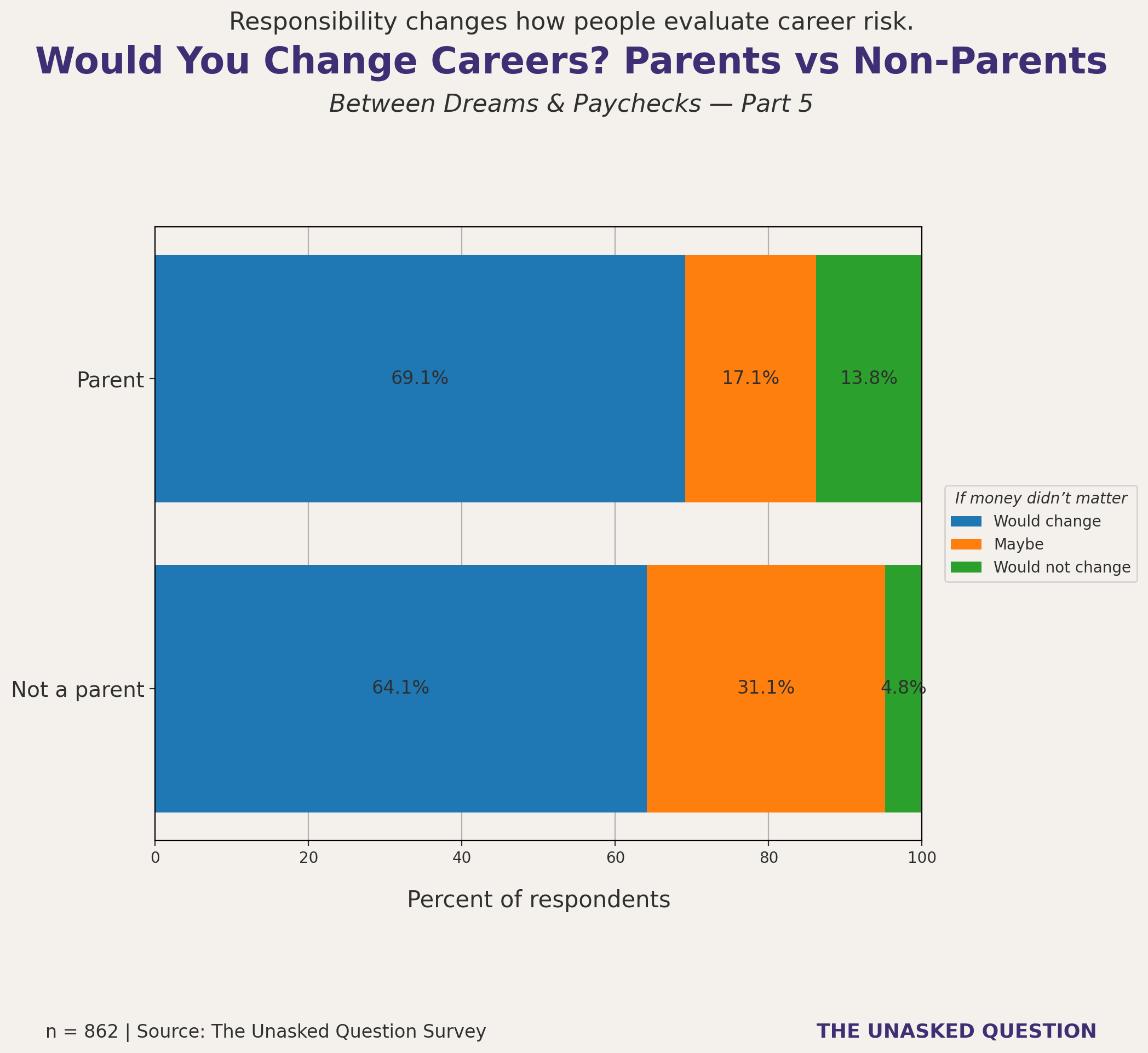
This chart compares how parents and non-parents respond to the question: “Would you change careers if money didn’t matter?” Parents show a higher likelihood of staying in their current path, highlighting how responsibility influences career risk tolerance.
One of the more persistent assumptions about career change is that it requires starting over. That a new direction means abandoning everything that came before.
In reality, most people don’t start from zero.
They reposition.
Skills transfer. Experience compounds. Networks carry forward. The path may shift, sometimes significantly, but it rarely resets entirely. Reinvention, for most, is not a clean break—it’s an adjustment built on what already exists.
Across this series, a consistent pattern has emerged. Early career decisions are shaped by practicality—income, security, opportunity. Over time, those decisions create stability. And alongside that stability, something else persists: awareness.
People continue to think about alternative paths. Not because they are deeply dissatisfied, but because they understand that different choices were always possible.
That awareness doesn’t disappear with experience—it sharpens.
But awareness alone doesn’t lead to action.
When respondents were asked where they hope to be in five years, many described a future that looks different from where they are today—more aligned, more flexible, or more fulfilling.
But when asked whether they are actively working toward a different career, far fewer said yes.
This reveals a gap that sits quietly beneath everything else in the data:
People often know where they want to go.
They’re just not always moving toward it.
This isn’t a lack of ambition.
It’s friction.
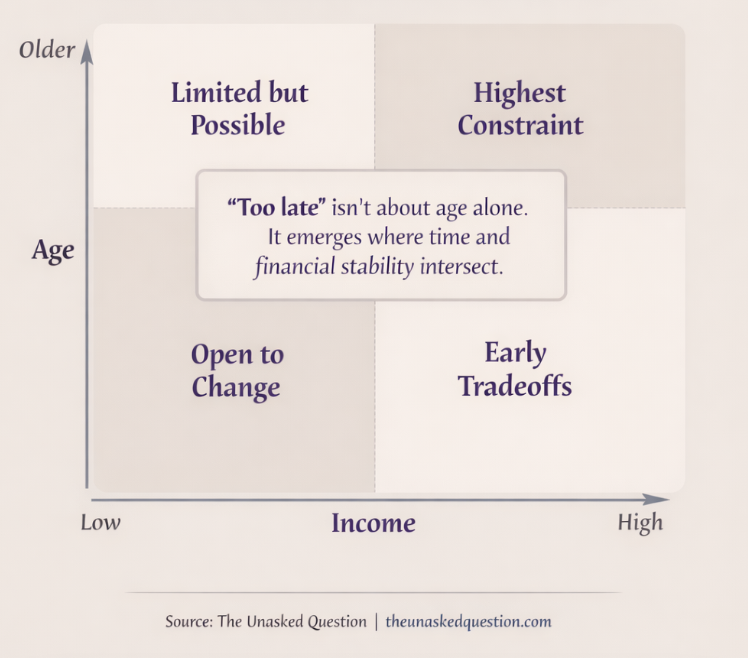
This conceptual framework maps how perceptions of career flexibility change based on age and income. It shows that feeling “too late” is not driven by age alone, but by the intersection of time and financial stability.
Financial risk. Career momentum. Uncertainty about outcomes. Competing responsibilities. The same forces that shaped earlier decisions continue to shape what feels possible now.
The result is something more subtle than indecision.
It’s what could be described as passive ambition—a state where people hold a clear vision of change, but don’t consistently act on it.
This creates a narrow but meaningful space.
Not the need to escape—but the opportunity to adjust.
Change, when it happens, rarely comes from a single moment of clarity. It tends to emerge gradually. Priorities shift. Interests evolve. The definition of success becomes more personal. What once felt like the right decision may still make sense—but no longer feel fully aligned.
Even then, action is not guaranteed.
Risk becomes the deciding factor.
From earlier in the data, most respondents are not willing to take extreme financial risks. Instead, they cluster around moderate, calculated tradeoffs. That pattern reframes the question entirely.
It’s not: Should I change everything?
It’s: What level of change is sustainable?
For some, that might mean a full transition into a different field. For others, it could be a shift in role, a gradual pivot, or the pursuit of something parallel to their current path.
Not all change needs to be dramatic to be meaningful.
In fact, most change isn’t.
What people appear to be optimizing for isn’t perfection—it’s balance.
Enough income to feel secure.
Enough interest to stay engaged.
Enough flexibility to adapt over time.
That balance is rarely achieved all at once. It’s adjusted, revisited, and redefined as life evolves.
At the beginning of this series, the question was simple:
Are people living their dream jobs?
The answer, consistently, was no—or at least, not exactly.
But that answer misses something more important.
Most people didn’t end up exactly where they imagined.
But they didn’t end up in the wrong place either.
They made decisions based on what they knew, what they needed, and what was possible at the time. And over time, those decisions created stability, experience, and perspective.
Now, with that perspective, the question shifts again.
Not to undo the past.
But to understand what can still change.
Between dreams and paychecks, most people are not choosing one or the other.
They are navigating between them—balancing tradeoffs, adjusting priorities, and occasionally reassessing the path they’re on.
Not because everything is wrong.
But because something could be better.
And that possibility—however constrained or uncertain—is what keeps the question alive.
Is it ever too late to choose differently?