Part 3: Stability, Passion, or Balance - What Did We Choose?
Between Dreams and Paychecks Series
The Hidden Logic Behind Career Decisions
Most career conversations start with a simple premise: follow your passion.
But when we look at how people actually choose their careers, the story becomes more complex.
In Part 2 of this series, 68% of respondents said they would change careers if money didn’t matter. It’s a compelling statistic—one that suggests many people are not fully aligned with what they once imagined for themselves.
But money does matter. And when we shift from hypothetical choices to real ones, a different pattern emerges.
Across 862 responses, career decisions cluster around three primary paths. The largest group—38.9%—reported choosing a balance between interest and pay. Another 28.8% prioritized financial reasons, while 22.2% emphasized stability and security. Only 8.9% described their careers as primarily driven by passion.
At first glance, this distribution might feel discouraging. If passion is the ideal, why does it represent such a small portion of actual decisions?
The answer becomes clearer when we look beyond motivation and consider outcomes.
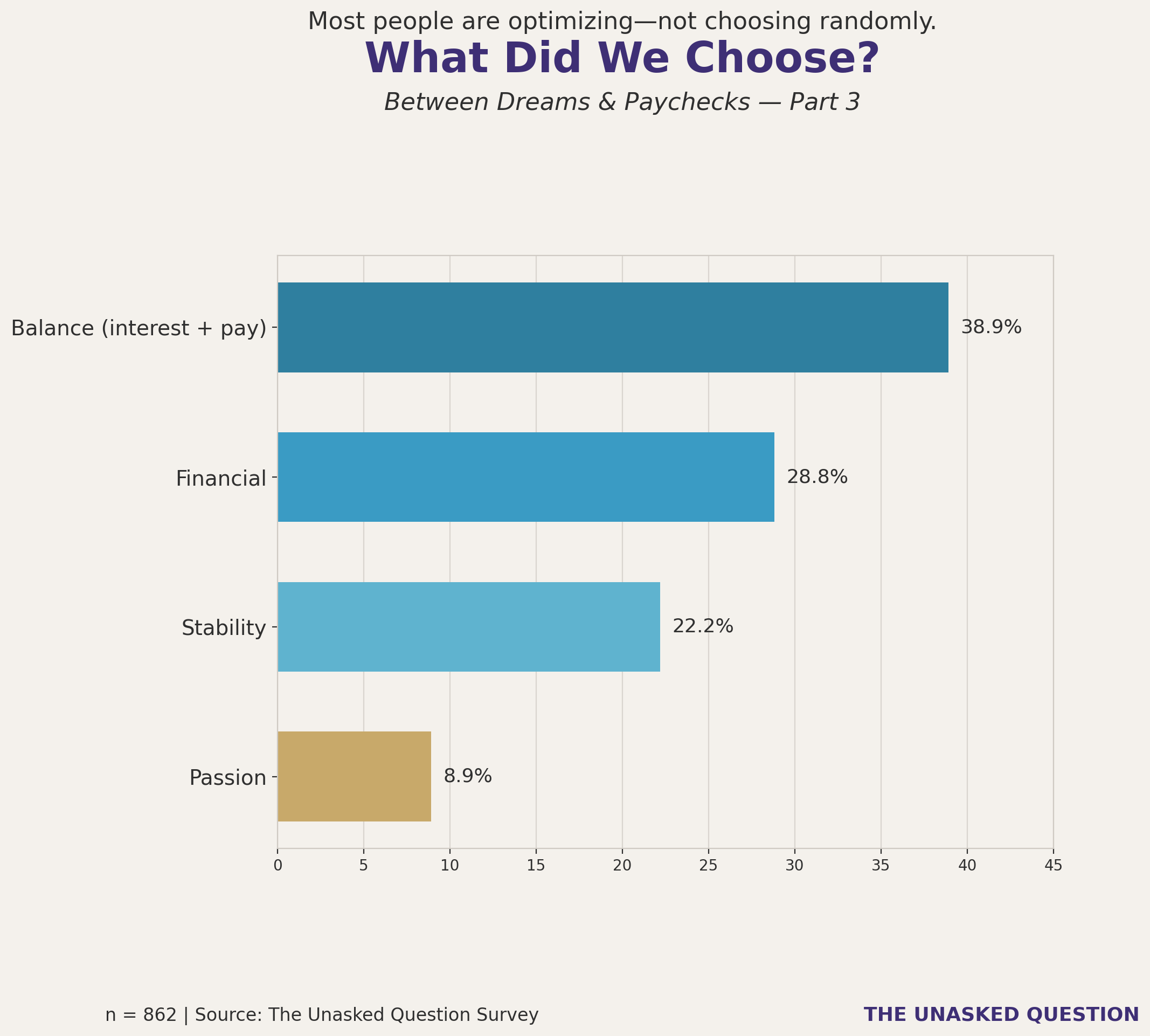
This chart displays how 862 survey respondents prioritized different factors in their career decisions. The largest group chose a balance between interest and pay (38.9%), followed by financial reasons (28.8%) and stability (22.2%), with only 8.9% selecting passion as their primary driver.
A Multi-Dimensional View of Career Decisions
Career choices are often framed as a tradeoff: passion versus paycheck. But this binary view overlooks an important dimension—what those choices actually produce.
When respondents were asked to rate their financial security, approximately 70% reported feeling moderately to highly secure (a rating of 4 or 5 out of 5). This suggests that the majority of individuals are not only prioritizing stability or financial considerations—they are achieving them.
This connection matters.
Because it reframes a common assumption. Choosing stability is often interpreted as settling, but the data suggests something different. For many, it is a deliberate strategy—one that leads to measurable outcomes like predictability, reduced stress, and long-term planning capacity.
For many, prioritizing stability isn’t settling—it’s producing financial security.
In other words, these decisions are not passive. They are effective.
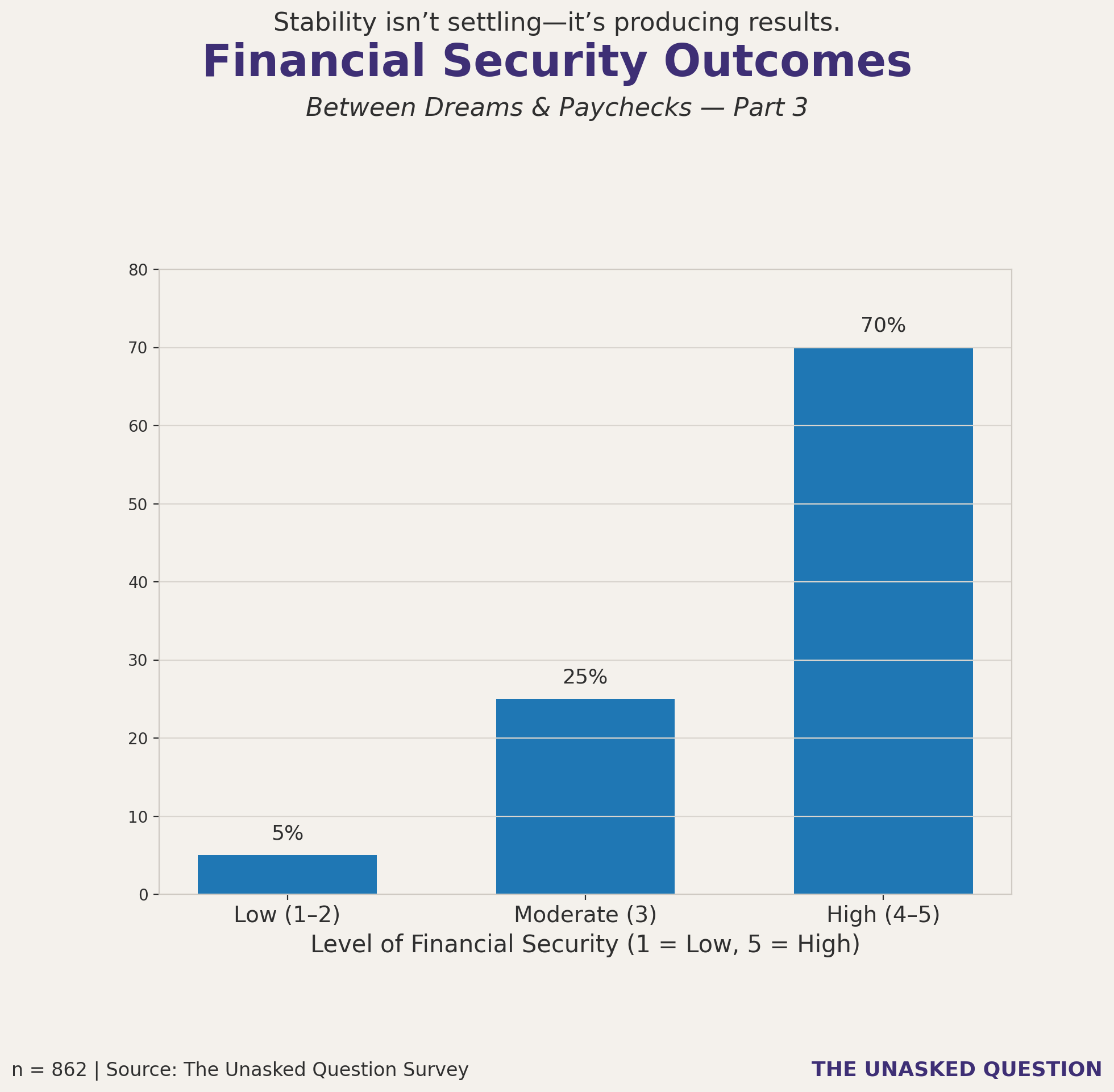
This chart illustrates how respondents rated their financial security on a scale from low to high. Approximately 70% of participants reported moderate to high financial security, suggesting that prioritizing stability and financial factors in career decisions often leads to stronger financial outcomes.
Where Passion Fits In
Despite the relatively small percentage of respondents who describe their careers as passion-driven, interest has not disappeared from the equation.
The fact that 68% would consider changing careers if money were removed as a constraint reveals that passion remains present—it is simply not always prioritized.
For many respondents, passion exists in a different form:
As something deferred to a later stage of life
As an interest pursued outside of work
Or as a component partially integrated into their current role
Rather than being abandoned, passion is often managed within the boundaries of financial and structural realities.
The Rise of Balance as a Strategy
The most common response—balancing interest and pay—points to a broader shift in how people approach careers.
But the data suggests this isn’t just about preference. It’s about outcomes.
When career motivations are compared alongside financial security, a pattern begins to emerge. Respondents who prioritized stability or financial considerations were more likely to report higher levels of financial security. Those pursuing passion-driven paths showed more variability in outcomes.
Where balance stands out is in the middle.
Rather than maximizing a single variable, this group appears to be managing tradeoffs—maintaining a level of financial security while still preserving some connection to personal interest.
Career motivations produce different outcomes—those prioritizing stability and financial factors report higher levels of financial security.
The relationship between career motivation and financial security is shown below.
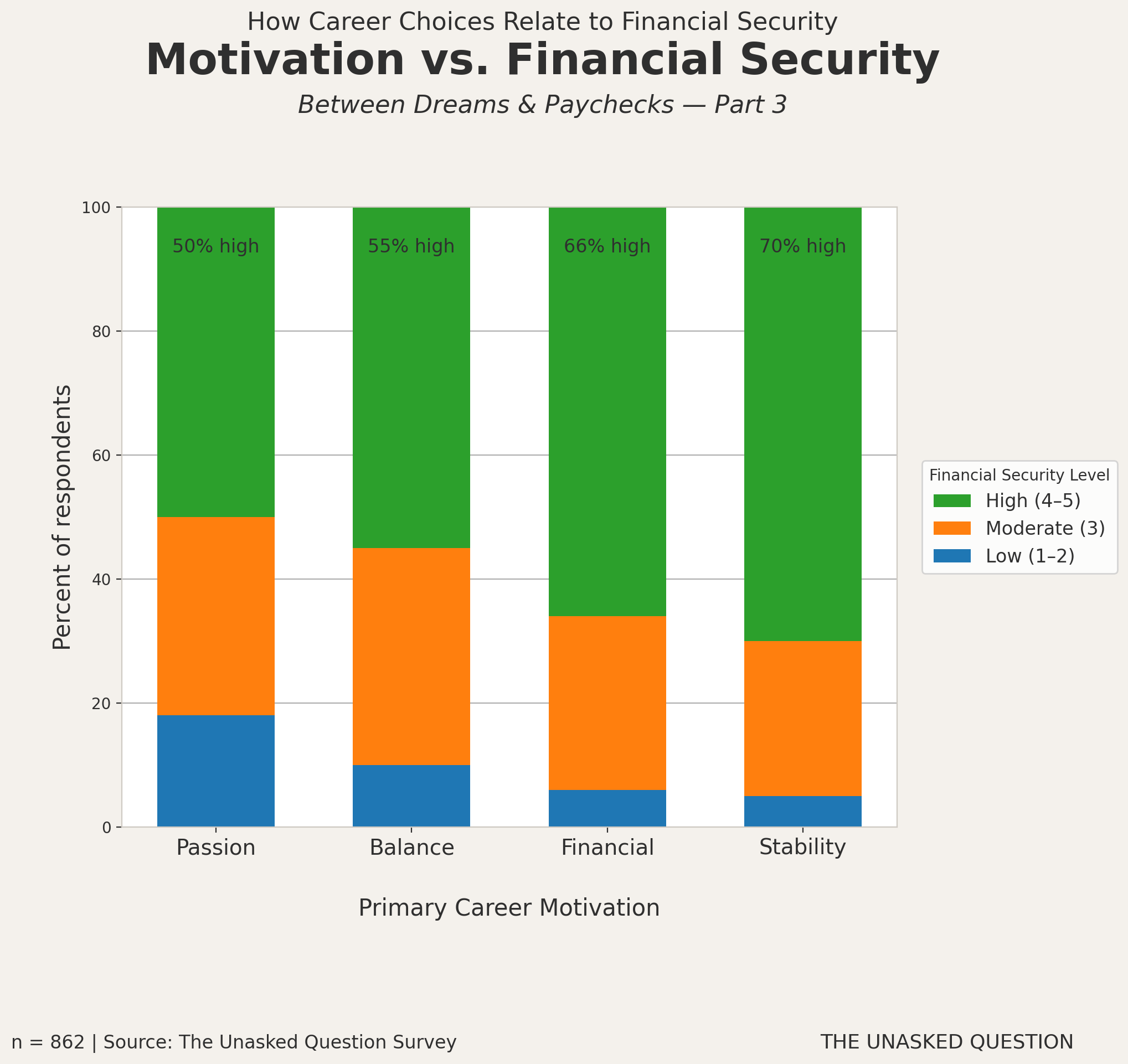
This chart compares career motivation types with reported financial security levels from a survey of 862 respondents. It shows that individuals who prioritize stability or financial outcomes are more likely to report high financial security, while passion-driven paths show greater variability.
Rethinking Tradeoffs
Every career path involves tradeoffs. Stability may limit flexibility. Passion may introduce uncertainty. Balance may require compromise on both ends.
But when these tradeoffs are viewed through the lens of outcomes, they begin to look less like losses and more like calibration.
The data does not indicate widespread dissatisfaction or regret. Instead, it reflects a population making calculated decisions—prioritizing what works within the constraints they face.
This is an important distinction.
Because it shifts the narrative from one of compromise to one of optimization.
Careers as Ongoing Adjustments
Another pattern emerges when these dimensions are considered together. High interest in career change (68%) coexists with high levels of satisfaction (~79%) and financial security (70%).
Rather than contradicting each other, these signals point to a more dynamic reality.
Careers are not static decisions. They are ongoing processes—shaped by evolving priorities, changing circumstances, and new opportunities.
People are not simply choosing once and living with the outcome. They are adjusting.
A Different Question
The question is often framed as:
Why aren’t more people following their dream job?
But the data suggests a more useful question:
What combination of priorities leads to a life that works?
For many respondents, the answer is not found at either extreme. It exists somewhere in the middle—where stability, interest, and practicality intersect.
And in many cases, that balance is not only intentional.
It’s effective.
Looking Ahead
Even when a path is working, it doesn’t eliminate reflection.
As priorities evolve, so do the questions people ask about their careers.
In Part 4, we explore that next layer:
Do people regret the paths they’ve taken—or simply wonder what else was possible?'
Follow The Unasked Question to continue the series.