Part 2: If Money Didn’t Matter, Would You Change Careers?
Between Dreams and Paychecks Series
How Financial Reality Shapes Our Choices
Most career advice assumes we are free to choose.
Follow your passion.
Take the risk.
Do what you love.
But real life rarely feels that simple.
Bills arrive before clarity does.
Responsibilities grow faster than paychecks.
And over time, the question quietly shifts from:
“What do I want to do?”
to
“What can I responsibly do?”
After exploring how closely people’s careers align with their childhood dreams in Part 1, we wanted to understand something deeper:
What role does money actually play in the choices we make?
The Question Behind the Question
In our survey of more than 850 respondents, we asked a simple hypothetical:
If money didn’t matter, would you change careers?
At first glance, it sounds like a fantasy question.
But the answers reveal something important about how people really feel about their work.
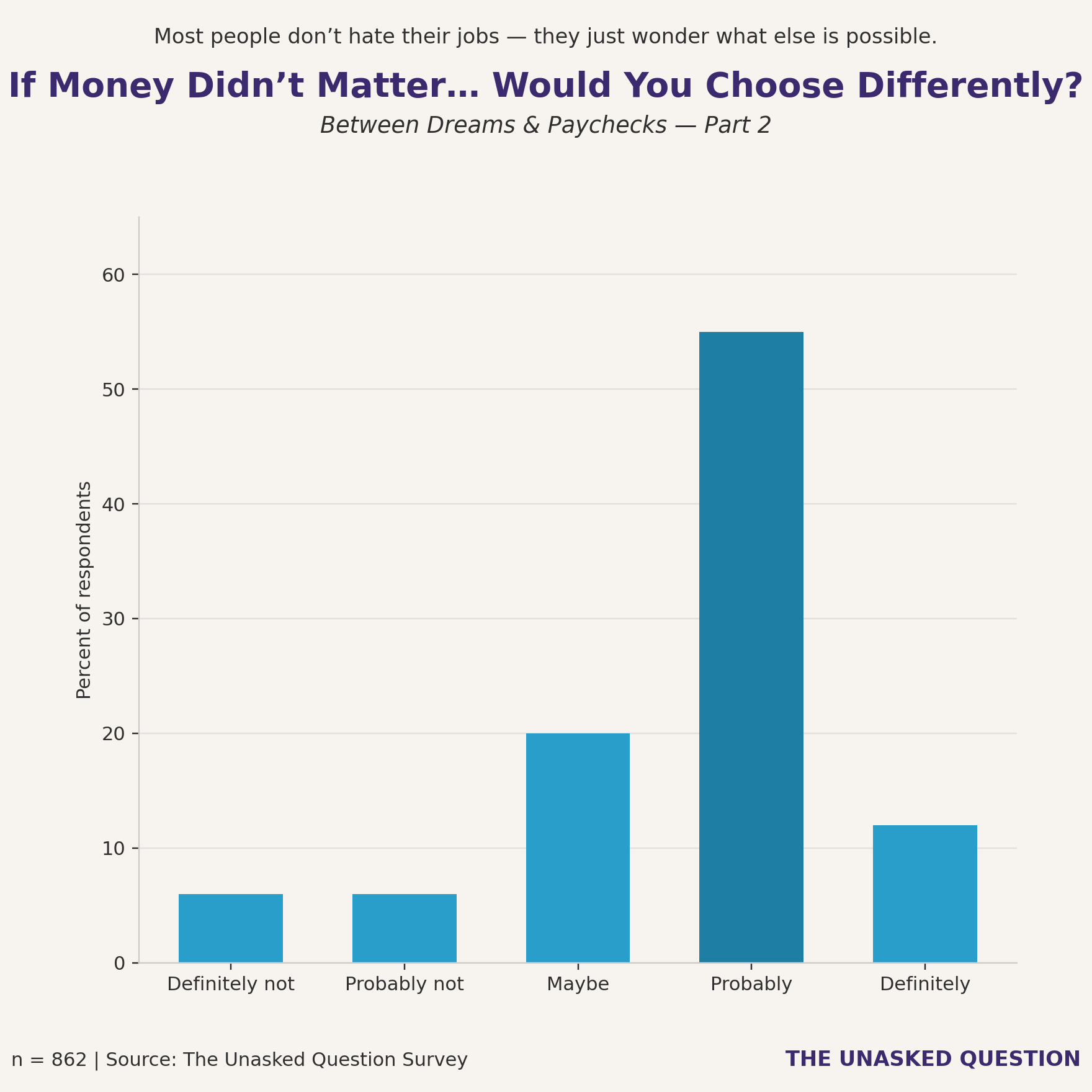
This chart visualizes responses from 862 participants asked whether they would change careers if money were not a factor. The largest group selected “Probably,” highlighting that financial considerations strongly influence career decisions. Part of the Between Dreams & Paychecks series by The Unasked Question.
The results were striking.
A strong majority said they would probably or definitely make a change.
Not because they were unhappy.
Not because they failed.
But because financial considerations quietly influence nearly every career decision we make.
Money is rarely the headline reason behind a career path.
But it is almost always in the background — shaping what feels possible.
The Quiet Influence of Stability
One of the most common misunderstandings about careers is the belief that people choose stability because they lack ambition.
The data suggests something different.
Most respondents weren’t chasing extreme outcomes. They were balancing competing needs:
security
flexibility
growth
responsibility
income predictability
In other words, many careers are not chosen purely out of passion or fear — but out of negotiation.
And negotiation is not the same thing as settling.
How Much Would People Sacrifice for Their Dream Job?
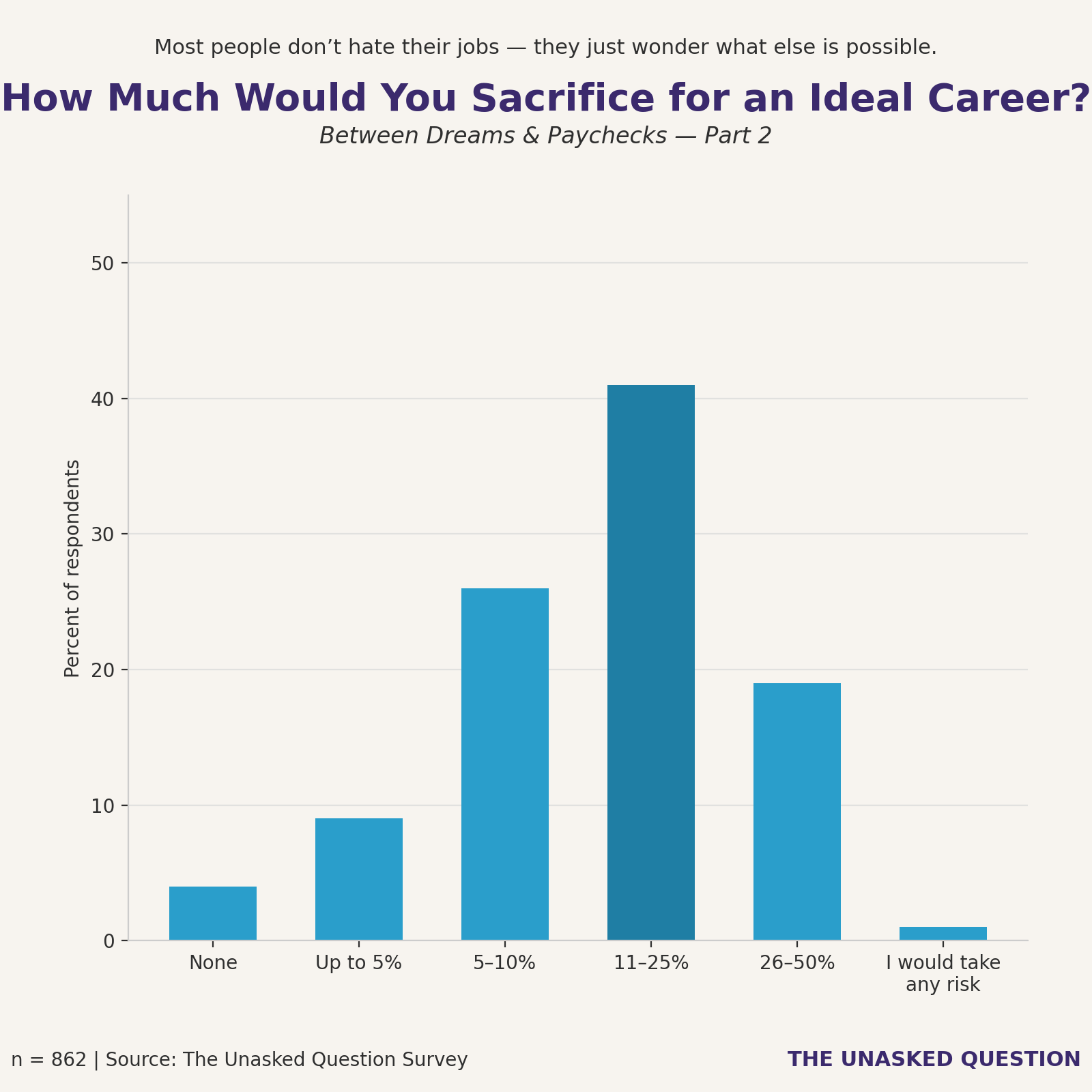
Survey chart showing how much income people would be willing to sacrifice to pursue their ideal career. Most respondents indicated a willingness to accept moderate pay reductions rather than extreme financial risk. Data collected from 862 participants for the Between Dreams & Paychecks series.
This question revealed a surprisingly hopeful pattern.
People were willing to sacrifice — but responsibly.
Many respondents said they would accept a moderate pay cut to move toward a dream role.
Very few were willing to take extreme financial risks.
This suggests something important:
Dreams still matter.
But so does stability.
For most people, the goal isn’t reckless reinvention. It’s sustainable fulfillment..
Dream Alignment vs Willingness to Change
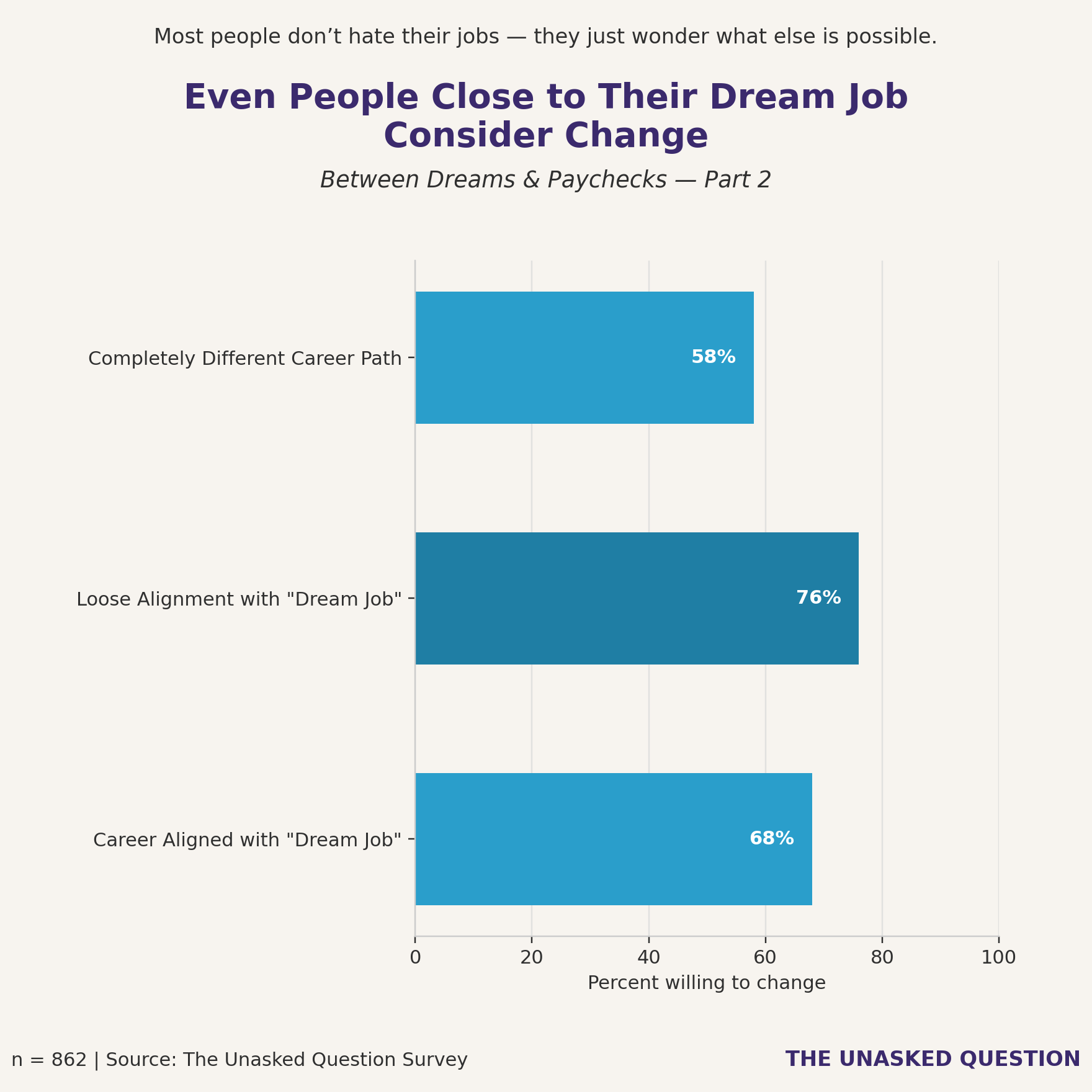
Survey visualization comparing willingness to change careers across levels of dream job alignment. The chart shows that even respondents who feel aligned with their dream job still consider career changes, illustrating ongoing curiosity and career evolution.
Even among those who felt close to their dream job, curiosity remained.
People don’t stop imagining alternatives just because they are satisfied.
The desire for change isn’t necessarily dissatisfaction.
Sometimes it reflects:
curiosity
growth
evolving identity
changing life priorities
This challenges the idea that fulfillment is a fixed destination.
For many, it’s an ongoing conversation.
The Myth of the Perfect Choice
Career decisions are often framed as singular moments — a major, a job offer, a turning point.
But the survey suggests something quieter.
Most people are constantly adjusting.
Small decisions add up:
choosing stability during certain life stages
prioritizing income when needed
pursuing meaning in different ways over time
Instead of one defining choice, careers look more like long-term adaptation.
Stability vs Passion
When asked what motivated their current career, many respondents chose balance over extremes.
Not passion alone.
Not security alone.
Balance.
This might be one of the most important findings in the series.
Because it suggests people are not giving up on dreams.
They are designing lives that can actually work.
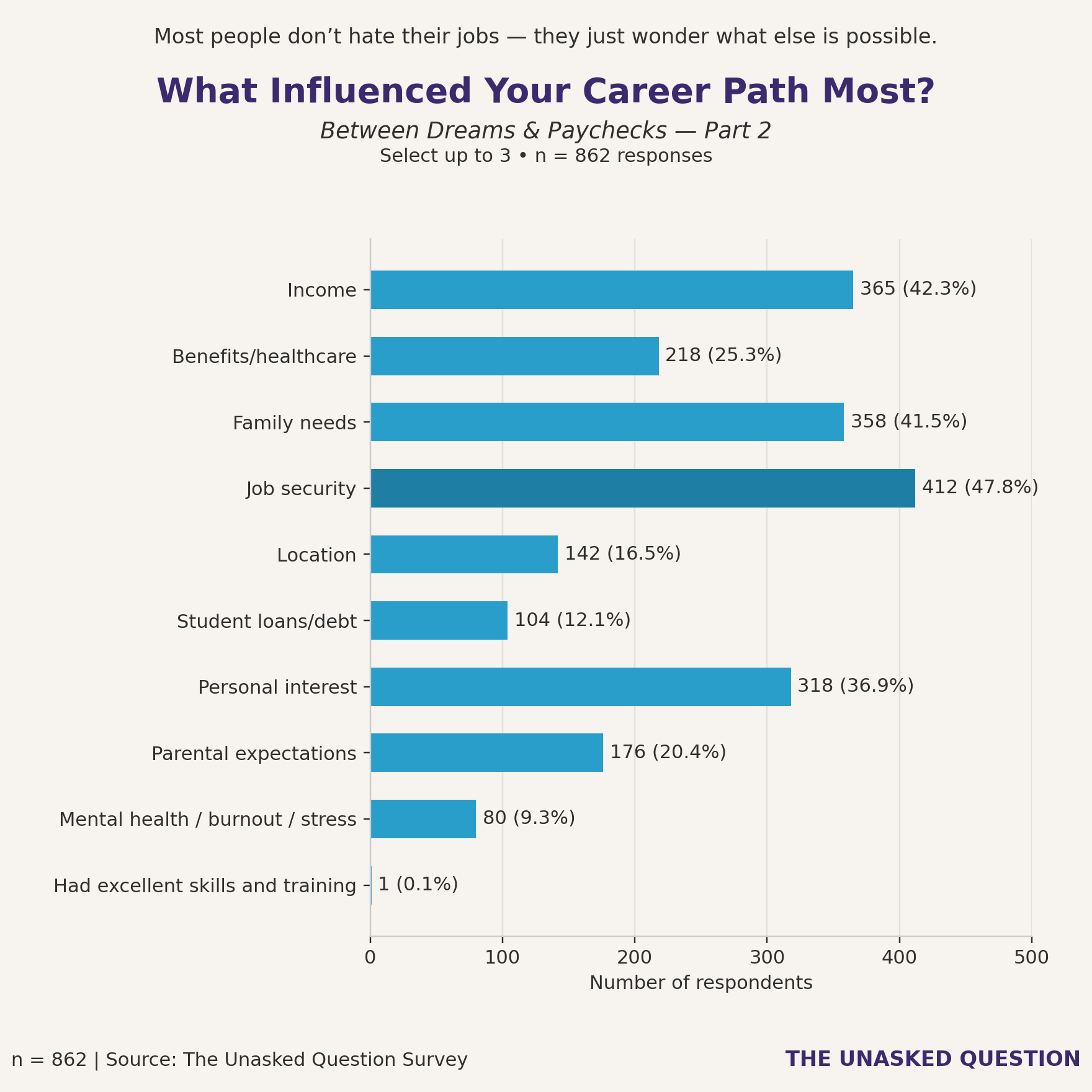
This chart ranks the most influential factors shaping career choices. Job security, income, and family needs were among the strongest drivers, showing that practical considerations often outweigh passion alone in real-world career decisions.
A More Honest Way to Talk About Money and Work
The phrase “if money didn’t matter” often sounds like a fantasy.
But this survey shows it’s really a mirror.
It reveals the tension many people live with:
Wanting growth while protecting stability.
Wanting purpose while maintaining responsibility.
Wanting change — without destroying what they’ve built.
These are not contradictory desires.
They are human ones.
What This Means
If Part 1 showed that dreams evolve, Part 2 shows why.
Money is not just a resource.
It is a boundary condition — shaping the timing, scale, and direction of our choices.
And yet, even within those boundaries, people continue to imagine alternatives.
That curiosity is not a sign of dissatisfaction.
It may simply be a sign that we never fully stop becoming.
Coming Next
In Part 3, we move beyond money to explore something even more personal:
How people justify the tradeoffs they’ve made — and what they tell themselves about balance, passion, and success.
Because the story isn’t just about what we choose.
It’s about how we make sense of those choices afterward.
Follow The Unasked Question to continue the series.