Part 1: Which Expense Splitting Arrangements Feel Most Fair?
When couples move in together, money often becomes one of the first shared systems—and one of the least clearly defined. We talk about love, commitment, and compromise, but far less about how rent gets paid or who covers the groceries.
So we asked.
In a recent survey of 700 U.S. adults who have been cohabiting in a relationship for longer than one month, we explored how shared household expenses are divided—and, more importantly, how fair those arrangements feel to the people living with them.
What we found challenges some common assumptions.
The Results at a Glance
When respondents were asked whether their current expense-splitting arrangement felt fair, the percentage who answered “Very fair” or “Somewhat fair” broke down as follows:
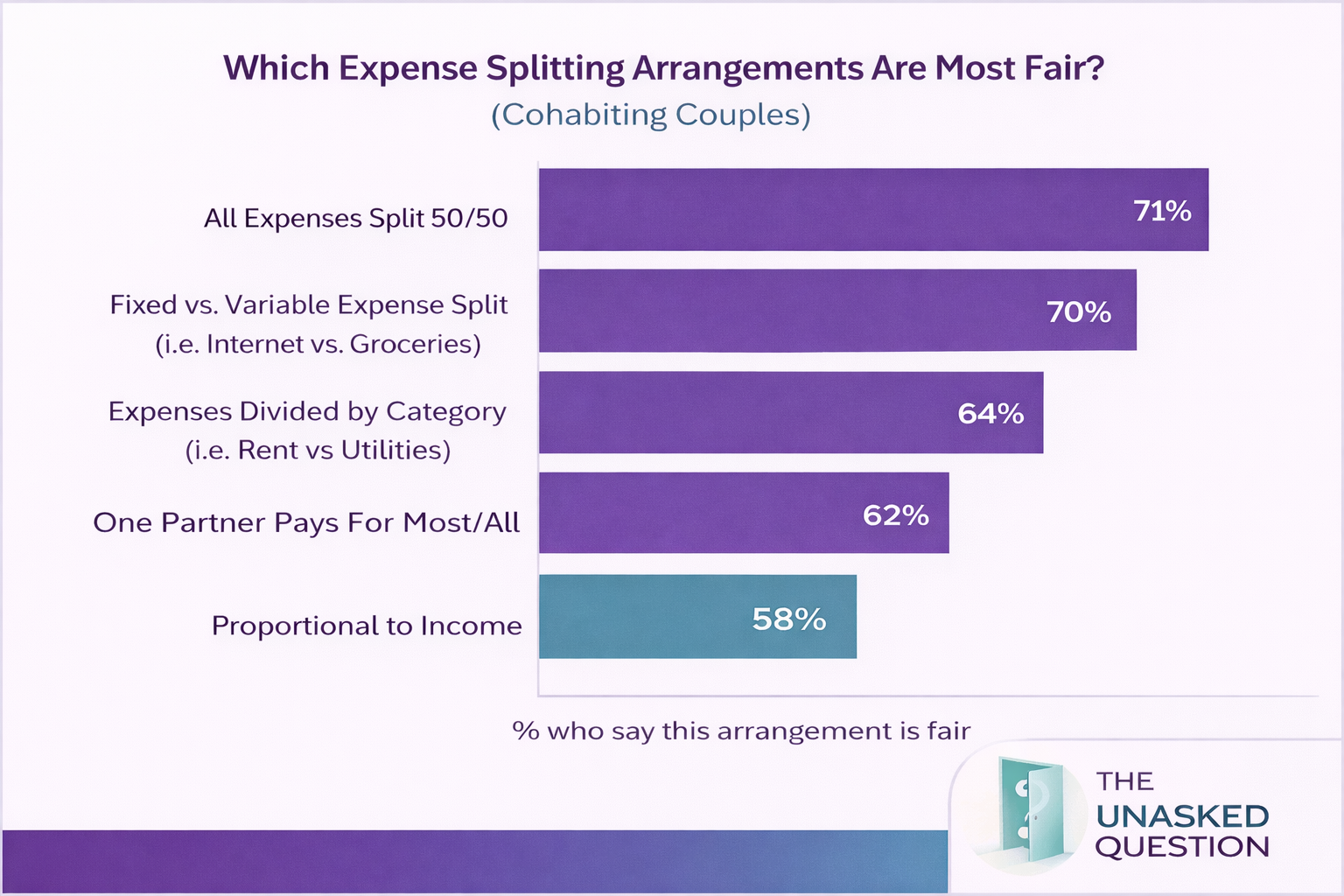
At first glance, this may seem unsurprising: splitting everything evenly ranks highest. But the differences between arrangements are smaller than many might expect.
What Stands Out
1. 50/50 feels fairest—but only slightly
An even split does rank highest, but only by a narrow margin. Several uneven arrangements cluster closely behind it, suggesting that equality is not the sole driver of fairness.
2. Unequal doesn’t automatically mean unfair
More than six in ten respondents said it felt fair when one partner paid most or all shared expenses. This challenges the idea that imbalance necessarily creates resentment.
3. Proportional to income ranks lowest
Despite being frequently recommended in advice columns, income-based splitting was rated least fair among the options we tested. That doesn’t mean it doesn’t work—but it may not feel as intuitive or satisfying in practice as it does in theory.
A Different Way to Think About Fairness
Taken together, the data suggests something subtle but important:
Fairness may be less about the formula—and more about agreement.
Couples appear willing to accept a wide range of financial structures as long as those arrangements align with expectations, roles, and perceived contributions beyond money alone.
In other words, fairness might be negotiated emotionally and contextually, not calculated mathematically.
The Unasked Question
Taken together, these results suggest that fairness in relationships is less rigid than we often assume. Different arrangements can feel equally acceptable, even when they look very different on paper.
That raises a follow-up question worth examining more closely:
If fairness isn’t simply about splitting things evenly, why do some of the most “logical” approaches feel less fair in practice?
Why This Matters
Money is one of the most common sources of tension in relationships, yet it’s often governed by habits, assumptions, or silence rather than explicit conversation. Understanding how people feel about their financial arrangements—rather than how they “should” work—helps make those invisible dynamics visible.
That’s what this project aims to do.
Not to prescribe answers—but to surface the questions we don’t often ask.
—
This analysis is part of an ongoing survey series by The Unasked Question, exploring everyday topics that shape our lives more than we realize.